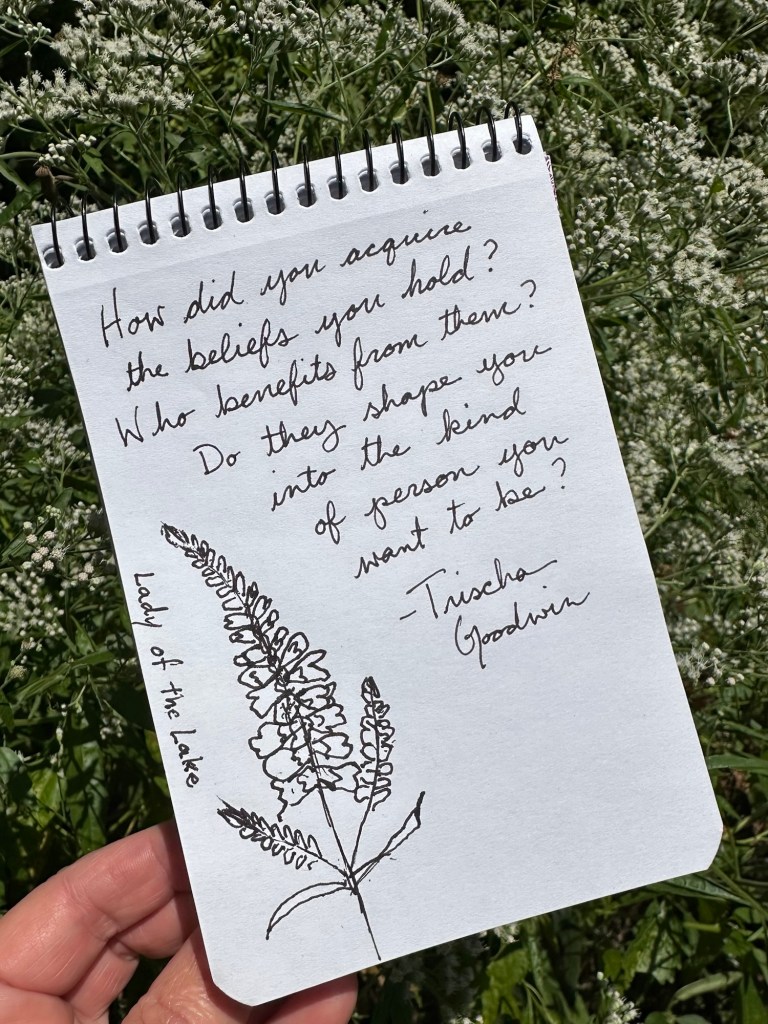
As someone who grew up in the Christian homeschooling movement and spent most of my time in conservative/evangelical Republican circles, who walked away from that nearly 15 years ago, spent some time in progressive/liberal Democrat circles, and who now considers myself without a political home–as someone who reads broadly on a variety of subjects because I want to understand how things work and are connected, I’ve been thinking about what I wish more people on “both sides” understood and would take some time to consider.
The Right and the Left might be opposing sides, but they are not at all organized or constructed as mirror opposites, despite many people seeming to think that they are. And in the U.S. we do not have a nation neatly divided into these two camps, despite many narratives claiming that we do. In the last presidential election, 31.5% voted Right, 30.6% voted Left, and 37.7% did not vote for either candidate. I’ve been thinking a lot about who benefits from us believing there are these two mirror-opposite sides and the construction of that “half-the-country” narrative we hear so often, when more people fall outside of the strict Left/Right divide than into it.
A massive amount of wealth and power have been poured into creating a Right that will rally around single issues and work with others who may have different opinions about other topics in order to accomplish political goals. There were architects of this as far back as Reconstruction, massively amped up after the Civil Rights movement, and then supercharged after Citizens United. The Right is so effective at getting even their most unpopular policies passed and their most unpopular politicians elected, partly because people on that side will overlook almost anything, even actions and policies that go against many of the other values they hold, in order to get policies and politicians that support their main issue–be it the 2nd amendment or abortion or whatever is the Christian-Right crusade of the hour. Endless resources have been targeted for decades to create an incredibly well-organized, Right-aligned voting block with influence and sway far outsized to their actual numbers.
And while, yes, there is a lot of money and power out there promoting liberal/progressive ideas, the Left is simply just not a powerful voting block. People on that side are often not only unwilling to set aside differences on other issues to accomplish a policy goal together, but they often devolve into ideological attacks and in-fighting over those differences and accomplish very litte. There are some exceptions, but I have read many examples of this and have seen this play out as I watched these spaces. This is a major factor in why the Left fails over and over again to pass even their most popular policies or have broadly popular political candidates. And I know that many on the Right think Democrats are super liberal or radical or leftist, but the reality is that the vast majority of Democrat politicians are actually neoliberals (like most Democrat and Republican presidents since Ronald Reagan), who, while they might promote some progressive social views, are truly incredibly conservative when it comes to the majority of policies they support. Democrat politicians, almost without fail, vote in the interests of corporations and the ruling class instead of the citizens they are supposed to represent. Because of this, many people who oppose the policies of the Right are completely disillusioned with the Democrat party as well and have checked out of national politics altogether.
I know it can be easy, if you’re on the Right, to think that the Left might be like your side, only with opposite views, but that is simply not the reality. They do not have the power and influence you are told they have. Are there Democrat-backed groups on the other side who might rally together around a cause or to call out something on the Right that they take issue with? Sure. Yes, there are. But these are groups of people, not a monolith. They are not representative of the entire other side and likely do not have the numbers to accomplish anything you are afraid that they might.
I know it can be easy if you’re on the Left, to be baffled by how so many people on the Right will support politicians and policies seemingly against their values and best interest, but that is because there is nothing equivalent to these single-issue coalitions on the Left. The ends very much justify the means in their minds, whereas the Left gets stuck in the means and barely ever accomplishes any ends.
And as much as we all like to think of “our side” as the good guys and the “other side” as the bad guys, the reality is that there are good and bad people on both sides. There are people on both sides who love their families and are trying to make it through life one day at a time, doing the best they can in their circumstances. There are people on both sides who behave terribly and harmfully and do all they can to demonize and dehumanize everyone they consider “other.” And there are good and bad people who fall outside of either side.
And I write all of this to ask, who is benefiting from this? Who benefits from us seeing the other side as though the worst of them is all of them? Who benefits from the Right, whose views and policies are often not supported by the majority, being such a powerful voting block? Who benefits from the Left being so disorganized and unable to accomplish anything, even implementing popular policies that have broad support across the political spectrum? Who benefits from the Right being so focused on only the areas where they disagree with the Left and the Left being so focused on only the areas where they disagree with each other? Who benefits from us thinking that our politics can be simplistically viewed as half the country vs. the other half of the country when the reality is that many have stepped away from both parties? Whose power and influence might be eroded if people on all sides focused instead on the areas where we agree and demanded policies to support those things?
These divisions are deliberate. They are crafted to keep us fighting each other so we will not fight for each other.
I don’t think it would be a bad idea for all of us to take some time for introspection. To perhaps step away from social media for a few, to go outside, to reconnect to our own humanity and values and evaluate who our beliefs are serving and if it might be time to make some changes.
At this point, I think finding our way back to ourselves and each other may be our only hope.
 The Forest and the Trees