[Image Description: black and white photo of a cloudy sky reflecting in a lake.]
People should not be excluded for things that are not their fault, especially kids who had nothing to do with adult actions and need their community. It’s wrong to shut them out.
I said these things, more or less, to the church elder in the church office after church.
I tried to say it meek and deferential like a Good Christian Girl, but below the surface I was fire, righteous rage, teenage defiance, and trembling with church-instilled fear.
I tried to be the Good Christian Girl for a very long time. I went away, returned, and tried on Good Christian Wife, Good Christian Mother, Good Christian Woman, too.
But I am a terrible actress with no poker face, and an insistence on a much more spacious God.
I wonder if he had any idea what I’d learn, that elder, that kind-hearted man turned instrument of patriarchy by church teachings, when he said to my face that it was not my place, but then changed his mind behind closed doors with other men.
I wonder if he knew I’d look back on that day and realize that any church that knows a teenage girl is right, but can’t say it to her face, is no place for her.
I was supposed to learn my place, but instead I became a cautionary tale in that kind of church, the wild woman in the wilderness of faith with scary ideas like there is enough for everyone and God is not a man, out here in an ever-widening circle of who’s included.
Ill-fitting facades, abandoned on shore, swimming naked in the waters, Spirit brooding over, waiting for what God will speak into existence next.
For months now, I’ve felt ill at ease reading the morning office. I had a sense of why—mainly the overtly male language for God—but not clarity. So I continued, as I have for years, all the while noticing and honoring the discomfort. This week, clarity came in the form of questions: “Is there space for me here? Is there room for my becoming, when everything is father and he and him and lord?”
Meanwhile, I’d taken on the practice of praying hand-over-sternum, to remind me that the Divine is within, part of me.
This morning, while silently praying the confession and also practicing my reminder of the Divine within, the word “we” became “I” and “you” became “us” and suddenly I sense there may be space for me after all.
This is what I love about liturgy. It gives us a reservoir within which we can wrestle and flounder and question, all while being held and buoyed and never alone.
Here is how it sounded this morning:
Most merciful God, I confess that I have sinned against us in thought, word, and deed, by what I have done, and by what I have left undone. I have not loved us with my whole heart; I have not loved my neighbors as myself. I am truly sorry and I humbly repent. For the sake of our Son Jesus Christ, have mercy on me and forgive me; that I may delight in our will, and walk in our ways, to the glory of your Name. Amen.
We’re not absolved just because we’re not on the side of the ones we see as worst.
Lulled into the laziness of giving allegiance willy-nilly, based on label, assigning morality by default instead of seeing morality is not innate, invariable, indelible, in each person.
The rightness or wrongness of an action depends on many factors, but a wrong is not magically a right when committed by one of ours.
What may seem like a tree we want to stand in the shade of, tend, and nurture, could be a danger, bearing poison fruit.
And so.
It is on each of us to consider our alliances, to evaluate words and actions, to look around at those attracted to align with us as we follow.
If the fruit is often rotten, sometimes poison, spreading more harm than good, we ourselves will eventually succumb.
Better to withdraw allegiance, dancing alone in the wilderness if necessary, than stay planted, growing roots, in an orchard of poison fruit.
[Image description: abstract photo with bright center]
Masculine. Feminine.
Words now defined as opposites, created prior to words as harmony among and within.
Interior balance of energy, each tantamount to the other, wholeness incarnate.
Diverse, yet coequal, until property, commodity, misogyny, took hold.
Multiple expressions of the feminine suppressed, confined, subdued, relegated to certain tasks and certain people.
God, divided.
We can call God Father, and he, and him, and Lord, and warrior, but not Mother, and she, and her, or even corresponding words that don’t exist because the default is always man.
I want the feminine side of God in all her forms.
Not to objectify God by claiming God a woman, the way women are objectified, claimed as God’s gift.
I want the wholeness, the fullness, the perfect entirety— without exclusion— of my own being. And God’s. And yours.
I want symmetry and reciprocity. The function and the beauty. The light and the shadow. The aspiration and the groundedness. The logic and the mystery. As it was. As it could be. If we didn’t split it all in two.
God is a man, male, maleness, and therefore, men are more like God. Women are just a rib, a support, a helper to prop up the weight of patriarchy.
It’s there in pages and creeds, who are you to argue? Ignore evidence that contradicts so all you see is a man’s faith, a man’s world a man god.
Kneel there and look pretty while we manufacture scarcity from abundance, violence from connection, commodity from gift.
How I long to clear away these accumulated lies the way one clears tracked-in fragments from the hall rug.
Quick snaps from the wrist, shaking clean over the back-porch rail, leaving the dross scattered in the yard to be washed clean away by the rain on the horizon.
Because the male god they made wasn’t male at all, just a distortion of power, maleness misconstrued.
Wholeness was the gift and we fractured it, splitting the beautiful spectrum of human into two opposites, one dominant.
Changing all/and into either/or, erecting boxes.
One for him. One for her. A facade for each
to stifle the complex beauty that allows us to be And. All. Whole.
The male god distortion crushes even men, separating us from each other and ourselves.
If we sweep away these constructs, confines, cons, we see God is male and not male, female and not female, being itself, not to be constricted by our narrow minds.
Out here in the vast expanse after the rain washes away the nonsense,
what we know is how wide and long and high and deep is being, is wholeness, is love.
[Image description: large wave crashing over a rocky, Maine shoreline]
At the mirror brushing teeth, thoughts crashing in waves, transferring energy one to the next, swelling and rippling back, until a single phrase surfaces:
You’ve always been this way.
Eyes search mirrored eyes, walking tidelines back to source.
Of course.
Of course.
Of course.
What seemed like newness was a return.
The fire in belly and bone over pain of another inflicted by power, illegitimate.
The having to say something— anything— to voice dissent even when voicing brought swift punishment from a wooden spoon, or the rebuke of an elder, or distance from friends.
Stifled, veneered, yet never completely cowed.
‘You’ve always been this way’ echoing until the waves still and there is only the calm of truth coming home.
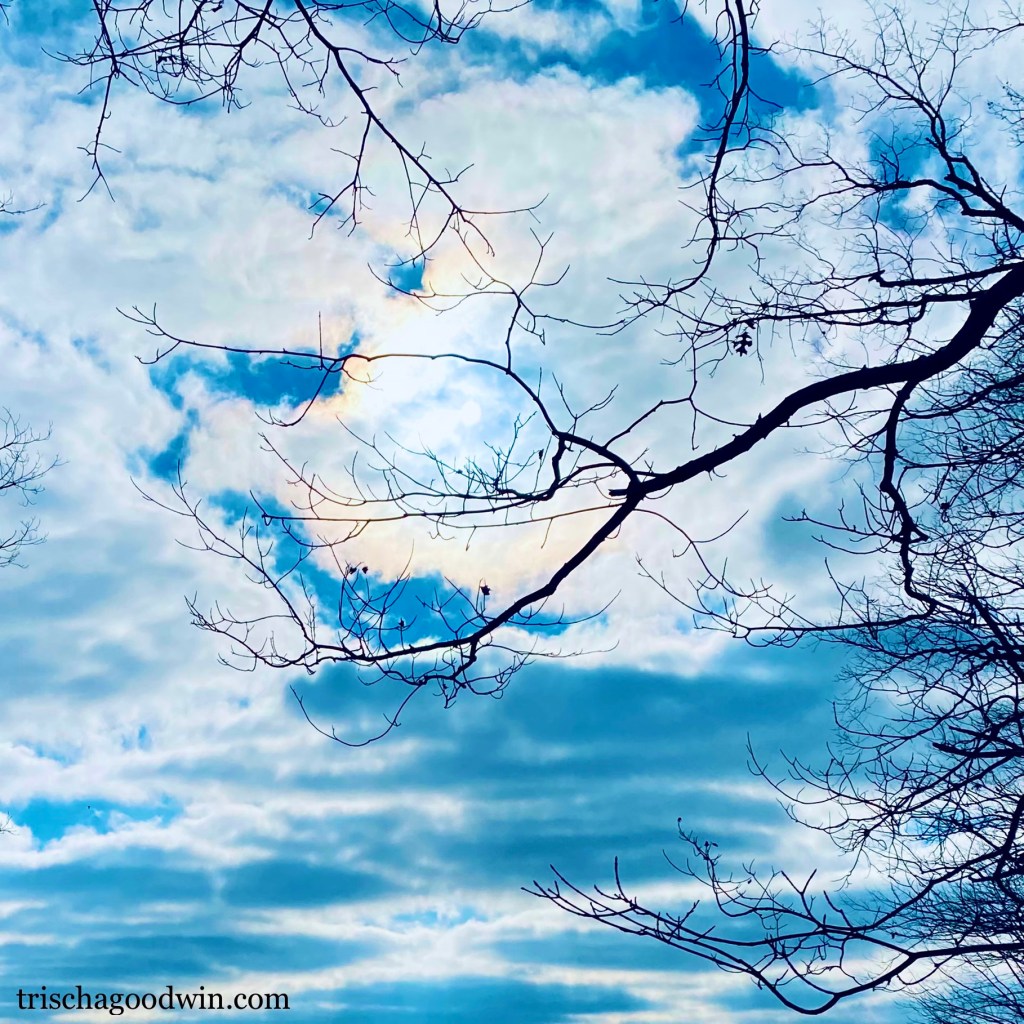
[Image description: Bare branches in front of a bright, cloudy sky]
‘In the Light: A Lament’
In the light of mourning, clarity. Sorting out which mundane things matter infinitely,
and which matters of past importance to set aside forever as time stretches out for some, past another’s time, cut short.
The unfairness pierces, piercing, pierced.
Different realities crafted to drive a wedge.
Some of us believing nurses and clinicians, experts and those bereaved, imperfectly trying to do our part. Some of us unmask our refusal to be inconvenienced for the sake of others, spreading falsehoods that kill.
Who gains when only some mourn the dead and see the weary eyes of those providing care for wave after wave after wave?
Which day do we designate for a day of mourning when thousands die every day and only some of us believe it didn’t have to be this way?
Will we ever grieve collectively the emptying seats in pews, cubicles, classrooms, break rooms, nurses stations, around dinner tables?
300,000 and counting.
When we fail to mourn together the lives lost to global tragedy because we can’t agree it is a tragedy here, the wound grows unchecked.
We need the searing light of mourning, need to allow it to shatter our hearts for the grief-stricken, the PPE-clothed witnesses, the ones no longer here.
But instead of holding vigil, we carry on like all is well or we withdraw completely or we deny or blame or fling outward an endless volley of hate.
None of which will heal or soothe or bring back a single person lost. We must find it in our hearts to grieve for the year, for our children, for ourselves, and especially for loved ones taken, and those they were taken from.
In the light of mourning, lament. As we see, bear witness, pay tribute, our hearts ache, open, and compassion can break through.








 The Forest and the Trees