[Image Description: Black and white photo of the moon with some tree branches in the foreground. (This photo was actually take the day before the full moon, as we had rain here on the night of the full moon that prevented me from capturing a good photo.)]
Yesterday’s full moon, the Hunger Moon, brought to mind words from scripture that tell us those who hunger and thirst for righteousness will be blessed.
A wise teacher taught me a way to think of righteousness is “to be in right relationship,” one of the most helpful teachings I’ve heard in a sermon.
Endless possibilities for the co-creation of right relationship— the earth, our community, our neighbor, the tree outside the window, the cashier at the supermarket, the technology we use, the entertainment we consume— everyone and everything we interact with has potential.
But do we hunger for that?
Robin Wall Kimmerer tells us her people, the Anishinaabe, called this moon the Hunger Moon because “the snow is too deep and the deer are gone and the caches are empty… After too many days, desperation is the only soup.”
It’s easy to imagine this, living close to the land and despite storing up for winter, running out of resources in the relentless dormancy of February.
What is difficult to reconcile, in our times of over-production to feed over-consumption, is how many still live in the shadows cast by the Hunger Moon, with desperation their only soup.
How far we are, as a culture, from righteousness, right relationship.
Kimmerer writes the Anishinaabe told their children tales of the Windigo, a human-turned-monster who consumes voraciously to the detriment of all, without ever being satiated, to ensure they knew the dangers of selfishness and excess.
The Hunger Moon brings reminders if we pause to ponder, that we can choose the path of righteousness, to live in right relationship, to hunger together to co-create a reality where everyone can have food and safety and joy and enough.
Or we can choose to follow the path of the Windigo where all that matters is our own hunger for more and what we are able to consume.
References to Robin Wall Kimmerer’s work are all taken from her book Braiding Sweetgrass, specifically the chapter ‘Windigo Footprints.’ I highly recommend.
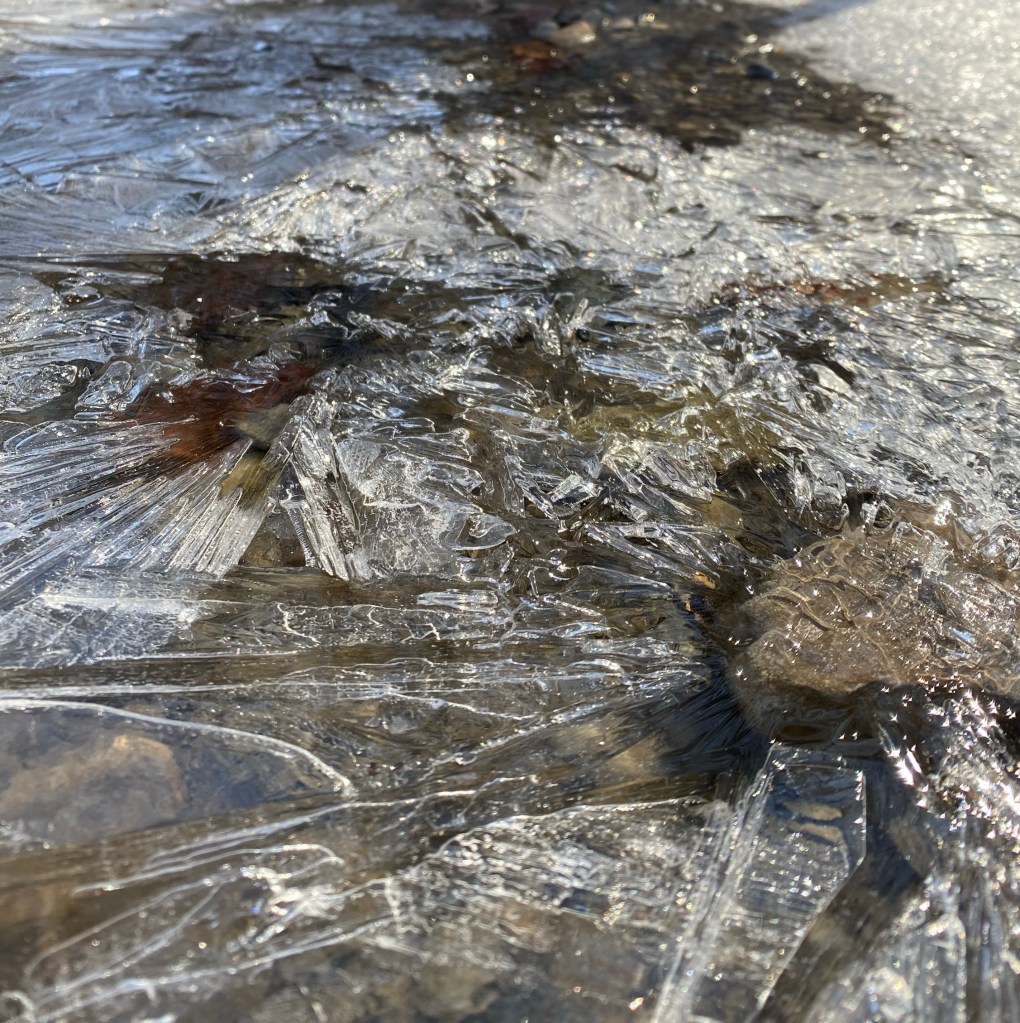
[Image Description: Close-up of ice crystals formed over a body of water]
A woman wrote my local, small-town paper to blame women for what ails our communities.
Men, she wrote, have vacated responsibilities and their rightful place because women have forgotten they were created equal— equal, but in the special role of helper— created for men, but now want to be like men, act like they are better than men.
About half the population to blame for all the problems.
Swift, visceral reaction upon reading, rage-typing uncharitable responses in my head for days.
I’ve deleted those lines one-by-one, realizing this is yet another retelling of the old myth I’ve heard since childhood: All that’s wrong is Eve’s fault and by default all women blamed.
Told enough times, layer upon layer, until myth is frozen, impenetrable.
Anger at this woman subsiding, remembering misogynistic, female-critical, woman-blaming narratives I internalized for years.
So much invested in making scapegoats believe they’re at fault until no one will question oppressive structures, abusive institutions, off-balance relationships, cis-male-dominated everything.
It takes time and wrestling to purge the narrative that if women do anything “wrong,” men could not possibly do anything right, to see that treating women merely as a helper to men objectifies, claims they exist to serve a function like a possession, and are not a unique expression of the divine image, of the stardust from which their atoms were formed, of the breath God breathed into their lungs.
Treating men as merely head of household providers reduces them to a role, like they are just a job, and not a unique expression of the divine image, of the stardust from which their atoms were formed, of the breath God breathed into their lungs.
And this binary trope treats anyone who is not one half of husband-and-wife, man-and-woman relationship, as absent, ignoring the truth that there are spectrums of experience, identity, relationship, and not everyone fits neatly into boxes and roles, nor wants to, and they are each just as much a unique expression of the divine image, of the stardust from which their atoms were formed, of the breath God breathed into their lungs.
I can’t free that woman and others like her by railing against.
But there is a beautiful invitation, a wild song, a burden lifted, out here where Eve is not a condemnation but our guide to a vast, spacious wilderness where we co-create with God new ways of being that don’t include taking responsibility for everyone else’s actions.
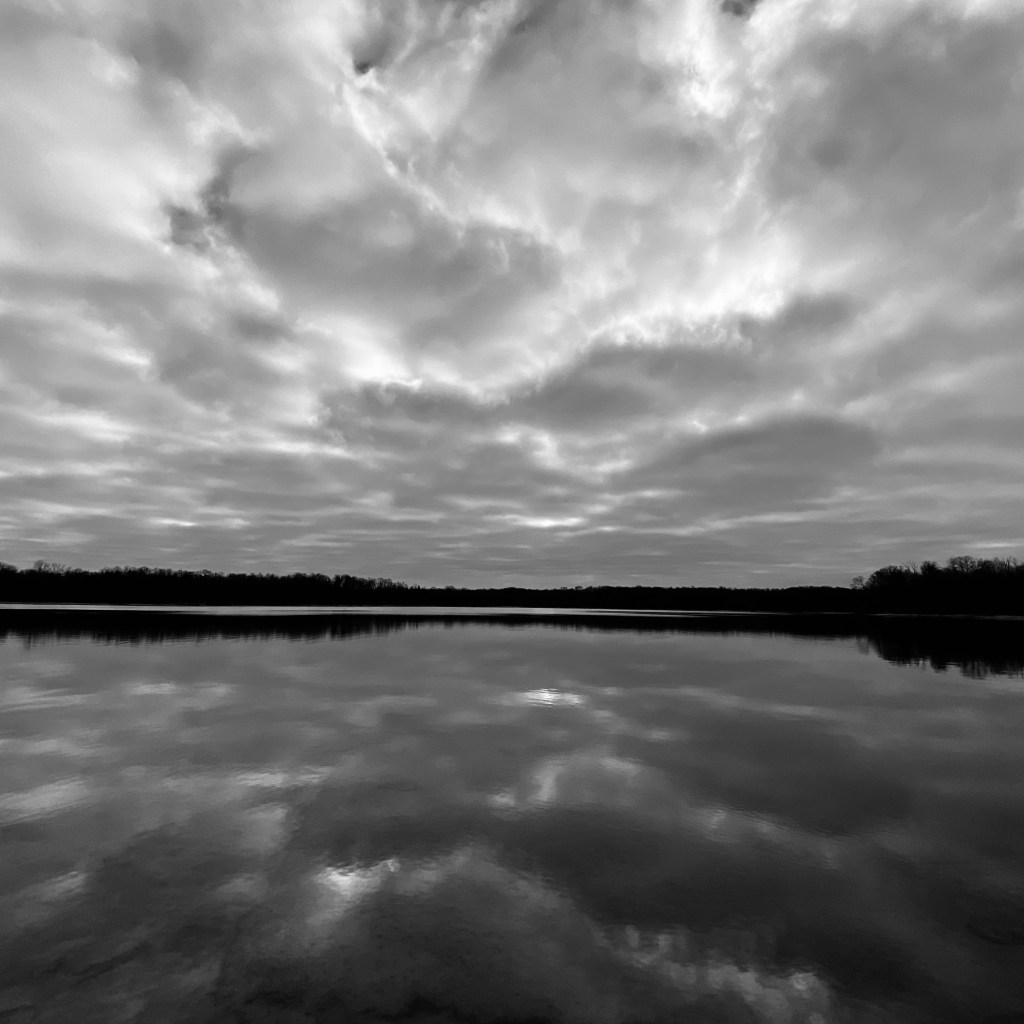
[Image Description: black and white photo of a cloudy sky reflecting in a lake.]
People should not be excluded for things that are not their fault, especially kids who had nothing to do with adult actions and need their community. It’s wrong to shut them out.
I said these things, more or less, to the church elder in the church office after church.
I tried to say it meek and deferential like a Good Christian Girl, but below the surface I was fire, righteous rage, teenage defiance, and trembling with church-instilled fear.
I tried to be the Good Christian Girl for a very long time. I went away, returned, and tried on Good Christian Wife, Good Christian Mother, Good Christian Woman, too.
But I am a terrible actress with no poker face, and an insistence on a much more spacious God.
I wonder if he had any idea what I’d learn, that elder, that kind-hearted man turned instrument of patriarchy by church teachings, when he said to my face that it was not my place, but then changed his mind behind closed doors with other men.
I wonder if he knew I’d look back on that day and realize that any church that knows a teenage girl is right, but can’t say it to her face, is no place for her.
I was supposed to learn my place, but instead I became a cautionary tale in that kind of church, the wild woman in the wilderness of faith with scary ideas like there is enough for everyone and God is not a man, out here in an ever-widening circle of who’s included.
Ill-fitting facades, abandoned on shore, swimming naked in the waters, Spirit brooding over, waiting for what God will speak into existence next.
I wrestle with this God, translated into male words, interpreted as male.
Half of everyone excluded, while everyone pretends it had to be this way until everyone believes it’s always been this way.
Better to teach people to worship a god made in man’s image so men in charge can have their way.
Here I am, not a man so not like God, unable to find myself anywhere other than on the outside.
I lie awake on nights I can’t pretend I don’t care and think about not belonging.
A few nights ago I slipped out of bed and pulled back the curtains to see the winter night and full-moon light.
I stood there in my not-man body, cold air raising goosebumps on bare legs, and leaned my head against the window glass, looking up to see the Wolf Moon in a veil of clouds.
I always marvel at the moon, her waxing, waning, rhythmic revelation, dancing with oceans from afar.
That night, watching silvery reflections of a star blending light and shadow across a frosty landscape, I think moonlight knows the truest words for God.
For months now, I’ve felt ill at ease reading the morning office. I had a sense of why—mainly the overtly male language for God—but not clarity. So I continued, as I have for years, all the while noticing and honoring the discomfort. This week, clarity came in the form of questions: “Is there space for me here? Is there room for my becoming, when everything is father and he and him and lord?”
Meanwhile, I’d taken on the practice of praying hand-over-sternum, to remind me that the Divine is within, part of me.
This morning, while silently praying the confession and also practicing my reminder of the Divine within, the word “we” became “I” and “you” became “us” and suddenly I sense there may be space for me after all.
This is what I love about liturgy. It gives us a reservoir within which we can wrestle and flounder and question, all while being held and buoyed and never alone.
Here is how it sounded this morning:
Most merciful God, I confess that I have sinned against us in thought, word, and deed, by what I have done, and by what I have left undone. I have not loved us with my whole heart; I have not loved my neighbors as myself. I am truly sorry and I humbly repent. For the sake of our Son Jesus Christ, have mercy on me and forgive me; that I may delight in our will, and walk in our ways, to the glory of your Name. Amen.
We’re not absolved just because we’re not on the side of the ones we see as worst.
Lulled into the laziness of giving allegiance willy-nilly, based on label, assigning morality by default instead of seeing morality is not innate, invariable, indelible, in each person.
The rightness or wrongness of an action depends on many factors, but a wrong is not magically a right when committed by one of ours.
What may seem like a tree we want to stand in the shade of, tend, and nurture, could be a danger, bearing poison fruit.
And so.
It is on each of us to consider our alliances, to evaluate words and actions, to look around at those attracted to align with us as we follow.
If the fruit is often rotten, sometimes poison, spreading more harm than good, we ourselves will eventually succumb.
Better to withdraw allegiance, dancing alone in the wilderness if necessary, than stay planted, growing roots, in an orchard of poison fruit.
[Image description: water cascading over a short rock ledge into a pool of water, rocks along the banks of the stream, bare winter trees and cloudy sky in the background]
I see myself divided, dividing. Ruptured, unleashing a torrent, thoughts cascading one over another at images I abhor.
Flooded, current ever outward, all reaction, counteraction, oppositional, all or nothing, with or against, how could you, dueling calls for unity or division, backlash into the void.
Visceral, swirling chaos, overtaking.
Nearly carried away, then clarity. Take a long breath and dive deep.
Remember.
I can roll back the tide of my own chaos, the crashing wave after wave clamoring noise in every second.
I can stem the barrage of endless opinions from ego unchecked.
I can gather in the deluge of outward-flooding emotions into a reservoir of my own making.
I can calm them, sitting in stillness, allowing silence to flow in.
I can see where light and shadow within me co-mingle, hear each other out, acknowledge my own inconsistencies, what troubles me about my own beliefs, how far I am from the standards I apply to others.
And I can hold these contradictions gently until the clashing parts become letting go, letting go, letting go.
Myself distilled to deepest truths until all of it is loved, is love.
Finally, reservoir to the brim, flowing over creating tide pools of compassion, invitations for others to look deep and see that they, too, are love.
And in the depths it’s clear true unity begins within my own united heart.