Willing

St. Patrick’s Episcopal Church
Lebanon, Ohio

I was engaged in the formal process of discerning a call to ordination for over a year. I submitted writing to the commission on ministry, had regular sessions with a spiritual director, and met with generous people from the diocese who were tasked with vetting and supporting those of us in the various states of discernment. I asked friends and colleagues to write recommendations. I went before panels to answer questions. I talked with my family about how things would change and how we would all feel about it if this was my path.

When that phase of discernment concluded and I’d met with the commission for the final time, all that was left to do was wait for their decision.

I was expecting a “yes” or “no,” but instead received what could be described as a “perhaps at some point.” After their own prayer and discernment, they shared they could potentially see me on that path, but that I did not seem certain it was the path I wanted to take. They recommended that I continue discerning on my own, and if the time came that I was sure ordination was my calling, then I should re-engage in the formal process.

It took months for me to let that answer sink in. I felt that I had failed to convey to them how willing I was to follow a formal call to ministry. Did I not communicate effectively? Did they see something deficient in me along the way?

Slowly I began to realize that I had communicated exactly where I was and that their answer was a most insightful one. The truth was right there all along: I was so willing to uproot my life and head down that path, that my willingness was all any of us could see.

Wrestling with this outcome, I had the rather painful realization that I wasn’t able to understand or communicate what I truly wanted in many cases, and that I had gone into the process looking for a formal authority to tell me what to do with my desire to find a new path. From a young age I had been taught that as a woman, I must rely on external direction to tell me what I should want and do. I was taught that it was wrong, even sinful, to trust where my own desires and spirit might guide me.

While pursuing ordination within a church understandably requires the direction and approval of its leadership, the initiation of that path comes from the Spirit directing that person, in alignment with their own longings and gifts. It was upsetting for me to see that as much as I had worked to walk away from the harmful teachings I learned growing up, that I still had a blind spot when it came to truly listening to and acting on my own inner wisdom.

Several months after receiving the decision and working to unpack the subsequent realizations, I wrote the following in my journal:

….getting to what I want feels impossible because it was so deeply instilled in me that selfishness was at the root of such consideration. I learned that I should always be willing, always defer. I learned to try to push myself aside for what I thought God or other people wanted or needed, or what I was told or expected to do.

What is coming to light for me is that willingness and deferring are hollow offerings. They lack life, generosity, and vulnerability. The life-giving, generous way of being is a beautiful offering of myself. It is me, showing up, wanting to be where I am, to give, engage, and create. As someone recently pointed out to me, “‘What do I want?’ is actually a profoundly spiritual question.” I sense this is true, and I want to live into where the answers take me, even as I am still trying to untangle from all the old ways of thinking and responding.

December 2018

That was over a year ago and I’m still in the midst of this reckoning. There are many layers to the subconscious patterns that keep me stuck in diminishing mindsets and habits. I still find myself sometimes saying a half-hearted yes to things out of a willingness to do them, rather than taking the time to discern where I can best show up with my whole-heart. There are times I don’t act or speak up, even when I know exactly what I want to do or say, due to the old thoughts that creep in to tell me that I should defer. However, I want to be intentional in my choices and pursuits, so I keep doing the work to untangle from these patterns.

I don’t know if this will take me back around to more discernment toward ordination, but I’ll always be grateful for what I learned in that time and how it has helped me grow in understanding myself. What I do know is that I am unwilling to remain in those old ways of being when there are so many more beautiful, spacious, truthful ways to live into who I’m meant to be.
That Time I Thought I’d Be a Priest

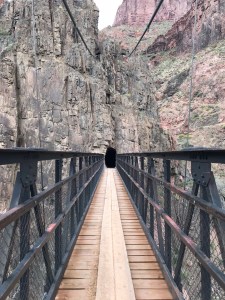
Grand Canyon, Inner Canyon, 2019
Native Land of the Hopi, Havasupai, Southern Paiute, and Pueblos (source native-land.ca)

There was a time in my life when I thought my path was shaping up like the picture above: onward to a destination forged by others, with (I hoped) something beautiful on the other side. My decision to explore that path seems like a suitable place to go from my first post, as it took place during part of the transitional, unraveling time in my life.

In 2016 I embarked on a discernment process to explore a possible call to ordained ministry in the Episcopal church. As part of that process, I had to write a faith story, with set criteria, to explain how faith had shaped my life and what brought me to the exploration. I’m sharing it in part below, As it gives a good background for where I am now.

Faith Story – Written January, 2017

The small Church of Christ up the street from where I lived with my parents and two younger sisters was central to our life during my childhood. Faith was lived mainly though our membership and participation with that congregation. My early years were filled with Sunday school, potluck dinners, Vacation Bible School, and other gatherings inside that small-town church. I don’t recall giving much thought to the broader church outside those walls, but I remember that place as a family community I am blessed to have roots in.

We left the Church of Christ in my early teens for a non-denominational church in a nearby town. While my early years revolved around a church family, my teenage years were steeped in the culture wars. I was taught to work hard at being more spiritual, more pure, and a better witness in order to gain approval from the congregation and from God. The faith I learned was one of rules and dogma, not only for me to follow, but to worry about how well other people were following. I realize that perhaps this isn’t how faith was understood by others in that community, but this is how I grew to understand it.

In the years that followed my graduation from college and marriage, I became disillusioned with church and eventually stopped attending. I experienced a painful time of deep doubt and searching, trying to sort out my beliefs. I wondered if I would lose my faith altogether and what would be there to catch me if I did. I thought that church wasn’t the place for me and that I’d end up leaving it behind for good.

Instead, people and wisdom came into my life that helped me reimagine not only my faith, but also my ideas about church. I established a practice of centering prayer and reading the Daily Office each morning, began spending more time in nature, and found friendships and spiritual writing that opened my eyes to a variety of perspectives and possibilities. I now see this was a process of letting go of my ideas about God in order to be open to new practices and new understandings of who God is.

A book by Thomas Keating on liturgy by prompted me to find a liturgical church to visit, which led me to a local Episcopal church. My first Sunday there, the words we read from The Book of Common Prayer moved me with how they connected those of us present in that sanctuary with people all over the world and across time. In many ways I felt like I was both being welcomed home and shown an entirely different way of understanding church as the body of Christ.

Some faith transformations are exciting and dramatic. Mine happens to be one of moving through a rigid understanding of God, faith, and church into one that continues to amaze me with its “holy spaciousness,” to borrow a phrase from Gerald May. I understand now that my faith is a continually unfolding grace that opens my mind and heart to God and to others. I see that the Church is a community where we help each other remember that as the Body of Christ we are always in the process of death and rebirth, letting go and finding anew, and learning to live deeper in self-giving love.

In all these changes, I’ve experienced how spiritual practices and participation in the church open us more fully to the work of the Spirit in our lives. I grew up memorizing scripture, but when I began reading the Daily Office, practicing contemplative prayer, and spending time with other believers learning from its wisdom, the Bible became so much more than words and rules to me… Over and over, I’ve experienced what the Spirit can do when I open to new understandings of scripture and give myself over to its life-altering truth.

In a talk I heard by John O’ Donohue, he closed by telling the audience that he prayed his words would be seeds planted in their lives to provide shelter when they need it. This has been helpful to me as I’ve explored the possibility of pursuing seminary and ordination. I realize that in following such a path it may be difficult for others to understand what I’m doing, either because due to my gender it doesn’t align with their understanding of the Christian faith or because religious faith is not a part of their lives. So I’ve made it a prayer of my own that regardless of how others feel about me, my faith, or my vocation, my interactions with them would plant seeds that could grow to shelter them, whatever their own experience and regardless of their beliefs.

I’ve also wondered about applying this to a way of being for the church. We live in a world that is starving for things the church has to offer. Not just the physical day-to-day necessities that sustain life, but also things that have become scarce in most of our homes, workplaces, and public spaces: life-giving community, a sense of reverence for the mysteries of life and this world, experiences of stillness and silence, a place to be vulnerable, an appreciation for things that have no monetary value, and traditions that remind us of our connectedness and our mortality. I wonder about ways we can offer these as seeds to our entire communities – those in the church and those not – so they can turn to them for shelter.

All these experiences have brought me to this point. I realize now that I’ve been praying about vocation for even longer than I knew what it was. I’ve considered that perhaps all I am called to do is to live my faith with my family, parish, neighbors, and co-workers, without any additional formal training or change of career. I realize that is a possibility, yet I continue to feel drawn to seminary and the changes that path could open. The advice I have received from Jackie (my priest) is to keep taking each step, to stay open to whatever possibility may come from that, and then to prayerfully and willingly take the next step.

I admit there is a part of me that wonders what I am doing. Most of those I’ve spoken with who are connected with Episcopal dioceses make it clear that we don’t know what the Episcopal Church, let alone the priesthood, will look like in the next 10 to 30 years. There is doubt that sustaining a full-time parish priest will be an option for the majority of congregations. Considering this, I can’t help but think there is a chance that even if I complete seminary and become ordained, I may still end up working an eight-to-five desk job as I do now, leaving many (including me) wondering what it was all for. Yet I find that I am compelled to continue exploring the possibility of ordination, even with these uncertainties.

I’m trying keep in mind what Parker Palmer writes in his book on vocation, that “there is as much guidance in what does not and cannot happen in my life as there is in what can and does.” This journey of discerning vocation has been a beautiful and life-giving challenge, one that I will continue to walk whether or not ordination is the path for me. I’m grateful for all I’ve learned and pray to stay willing and open to wherever God leads from here.