[Image description: Sun setting over a parking lot, with a small tree in the foreground]
I’ve thought of you more often than usual these past few days, most recently in a conversation on race and sexuality where I shared ideas you taught me.
Later, I walked in the woods feeling grateful to you for your generous wisdom. Sad I couldn’t remember the day, I looked it up. Four years ago this month
it was cold and I was sitting in the car outside a rundown gymnasium in a nearby town where one of my kids was practicing soccer.
First one, then another, there on social media, posts saying you were gone. It was sudden, unexpected.
Folks I only knew online, sharing about you, who I only knew online, all connected as participants in a weekly Twitter chat on queer theology
that taught me not to relinquish my faith to something smaller, not to surrender divinity to those who would diminish it,
not to abandon mystery to those who want to contain it, not to resign myself to traditions that no longer fit.
Your joy and big heart reaching me all the way from the west coast and soon we were sharing recipes and discussing our latest eco-friendly swaps.
I watched the way you interacted with people who didn’t have your understanding in a way that made them wish they did, a kind-hearted, fierce way that taught the rest of us so much.
From you I learned how easy it is to miss harmful isms and phobias that can pervade even seemingly good causes when I’m not their target. And to be always learning, always listening to those who are.
So often I’ve done my best to highlight something problematic in a way that honors your legacy, saying, “My friend Jane helped me understand…” Other times I find myself thinking, “Jane would love this.”
I wish I could send you reusable glass straws because they are far better than stainless. I wish I could meet you in person and that all the people who love you weren’t going into their fifth year without you.
I know I am both a better person for having connected with you and still have far to go in all the learning you helped inspire me to pursue. I miss your presence and your friendship, Jane. And I thank you for your light.
Note: I took the photo above right before I found out about Jane’s passing, and posted it the next day with the following caption: “Sunset last night while I was waiting at soccer, right before I found out my beautiful friend Jane passed away that afternoon. I never had the chance to meet her in person, but she was a wise and loving soul who I admired and learned so much from. I will miss her insight and compassion, and remember her for her fierce devotion to the friends and family she held dear, her passionate care for LGBTQ youth and others from marginalized communities, and her appreciation for the art of cooking. May the many mourning her passing be comforted by the love and light she shared with all of us.“
[Image Description: Black and white photo of the moon with some tree branches in the foreground. (This photo was actually take the day before the full moon, as we had rain here on the night of the full moon that prevented me from capturing a good photo.)]
Yesterday’s full moon, the Hunger Moon, brought to mind words from scripture that tell us those who hunger and thirst for righteousness will be blessed.
A wise teacher taught me a way to think of righteousness is “to be in right relationship,” one of the most helpful teachings I’ve heard in a sermon.
Endless possibilities for the co-creation of right relationship— the earth, our community, our neighbor, the tree outside the window, the cashier at the supermarket, the technology we use, the entertainment we consume— everyone and everything we interact with has potential.
But do we hunger for that?
Robin Wall Kimmerer tells us her people, the Anishinaabe, called this moon the Hunger Moon because “the snow is too deep and the deer are gone and the caches are empty… After too many days, desperation is the only soup.”
It’s easy to imagine this, living close to the land and despite storing up for winter, running out of resources in the relentless dormancy of February.
What is difficult to reconcile, in our times of over-production to feed over-consumption, is how many still live in the shadows cast by the Hunger Moon, with desperation their only soup.
How far we are, as a culture, from righteousness, right relationship.
Kimmerer writes the Anishinaabe told their children tales of the Windigo, a human-turned-monster who consumes voraciously to the detriment of all, without ever being satiated, to ensure they knew the dangers of selfishness and excess.
The Hunger Moon brings reminders if we pause to ponder, that we can choose the path of righteousness, to live in right relationship, to hunger together to co-create a reality where everyone can have food and safety and joy and enough.
Or we can choose to follow the path of the Windigo where all that matters is our own hunger for more and what we are able to consume.
References to Robin Wall Kimmerer’s work are all taken from her book Braiding Sweetgrass, specifically the chapter ‘Windigo Footprints.’ I highly recommend.
[Image Description: Close-up of ice crystals formed over a body of water]
A woman wrote my local, small-town paper to blame women for what ails our communities.
Men, she wrote, have vacated responsibilities and their rightful place because women have forgotten they were created equal— equal, but in the special role of helper— created for men, but now want to be like men, act like they are better than men.
About half the population to blame for all the problems.
Swift, visceral reaction upon reading, rage-typing uncharitable responses in my head for days.
I’ve deleted those lines one-by-one, realizing this is yet another retelling of the old myth I’ve heard since childhood: All that’s wrong is Eve’s fault and by default all women blamed.
Told enough times, layer upon layer, until myth is frozen, impenetrable.
Anger at this woman subsiding, remembering misogynistic, female-critical, woman-blaming narratives I internalized for years.
So much invested in making scapegoats believe they’re at fault until no one will question oppressive structures, abusive institutions, off-balance relationships, cis-male-dominated everything.
It takes time and wrestling to purge the narrative that if women do anything “wrong,” men could not possibly do anything right, to see that treating women merely as a helper to men objectifies, claims they exist to serve a function like a possession, and are not a unique expression of the divine image, of the stardust from which their atoms were formed, of the breath God breathed into their lungs.
Treating men as merely head of household providers reduces them to a role, like they are just a job, and not a unique expression of the divine image, of the stardust from which their atoms were formed, of the breath God breathed into their lungs.
And this binary trope treats anyone who is not one half of husband-and-wife, man-and-woman relationship, as absent, ignoring the truth that there are spectrums of experience, identity, relationship, and not everyone fits neatly into boxes and roles, nor wants to, and they are each just as much a unique expression of the divine image, of the stardust from which their atoms were formed, of the breath God breathed into their lungs.
I can’t free that woman and others like her by railing against.
But there is a beautiful invitation, a wild song, a burden lifted, out here where Eve is not a condemnation but our guide to a vast, spacious wilderness where we co-create with God new ways of being that don’t include taking responsibility for everyone else’s actions.
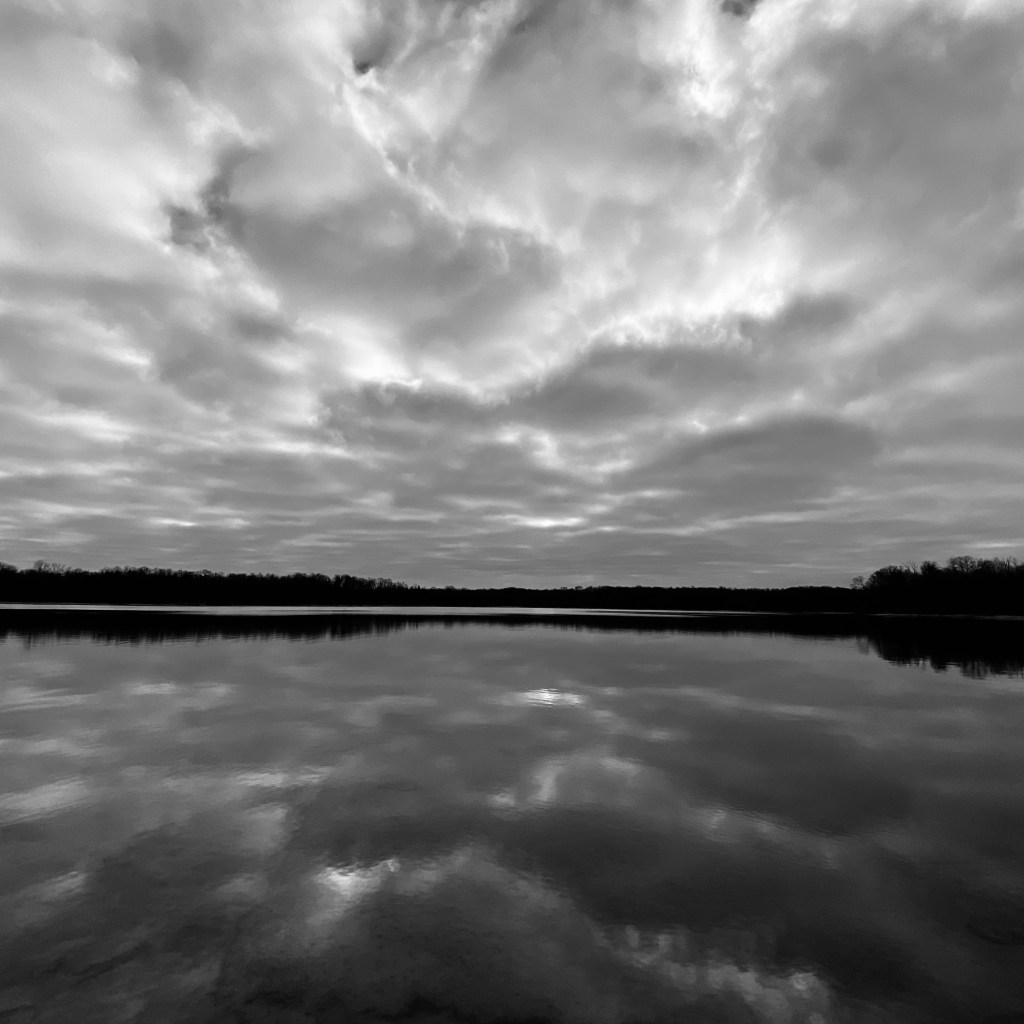
[Image Description: black and white photo of a cloudy sky reflecting in a lake.]
People should not be excluded for things that are not their fault, especially kids who had nothing to do with adult actions and need their community. It’s wrong to shut them out.
I said these things, more or less, to the church elder in the church office after church.
I tried to say it meek and deferential like a Good Christian Girl, but below the surface I was fire, righteous rage, teenage defiance, and trembling with church-instilled fear.
I tried to be the Good Christian Girl for a very long time. I went away, returned, and tried on Good Christian Wife, Good Christian Mother, Good Christian Woman, too.
But I am a terrible actress with no poker face, and an insistence on a much more spacious God.
I wonder if he had any idea what I’d learn, that elder, that kind-hearted man turned instrument of patriarchy by church teachings, when he said to my face that it was not my place, but then changed his mind behind closed doors with other men.
I wonder if he knew I’d look back on that day and realize that any church that knows a teenage girl is right, but can’t say it to her face, is no place for her.
I was supposed to learn my place, but instead I became a cautionary tale in that kind of church, the wild woman in the wilderness of faith with scary ideas like there is enough for everyone and God is not a man, out here in an ever-widening circle of who’s included.
Ill-fitting facades, abandoned on shore, swimming naked in the waters, Spirit brooding over, waiting for what God will speak into existence next.
For months now, I’ve felt ill at ease reading the morning office. I had a sense of why—mainly the overtly male language for God—but not clarity. So I continued, as I have for years, all the while noticing and honoring the discomfort. This week, clarity came in the form of questions: “Is there space for me here? Is there room for my becoming, when everything is father and he and him and lord?”
Meanwhile, I’d taken on the practice of praying hand-over-sternum, to remind me that the Divine is within, part of me.
This morning, while silently praying the confession and also practicing my reminder of the Divine within, the word “we” became “I” and “you” became “us” and suddenly I sense there may be space for me after all.
This is what I love about liturgy. It gives us a reservoir within which we can wrestle and flounder and question, all while being held and buoyed and never alone.
Here is how it sounded this morning:
Most merciful God, I confess that I have sinned against us in thought, word, and deed, by what I have done, and by what I have left undone. I have not loved us with my whole heart; I have not loved my neighbors as myself. I am truly sorry and I humbly repent. For the sake of our Son Jesus Christ, have mercy on me and forgive me; that I may delight in our will, and walk in our ways, to the glory of your Name. Amen.
We’re not absolved just because we’re not on the side of the ones we see as worst.
Lulled into the laziness of giving allegiance willy-nilly, based on label, assigning morality by default instead of seeing morality is not innate, invariable, indelible, in each person.
The rightness or wrongness of an action depends on many factors, but a wrong is not magically a right when committed by one of ours.
What may seem like a tree we want to stand in the shade of, tend, and nurture, could be a danger, bearing poison fruit.
And so.
It is on each of us to consider our alliances, to evaluate words and actions, to look around at those attracted to align with us as we follow.
If the fruit is often rotten, sometimes poison, spreading more harm than good, we ourselves will eventually succumb.
Better to withdraw allegiance, dancing alone in the wilderness if necessary, than stay planted, growing roots, in an orchard of poison fruit.