[Image description: large wave crashing over a rocky, Maine shoreline]
At the mirror brushing teeth, thoughts crashing in waves, transferring energy one to the next, swelling and rippling back, until a single phrase surfaces:
You’ve always been this way.
Eyes search mirrored eyes, walking tidelines back to source.
Of course.
Of course.
Of course.
What seemed like newness was a return.
The fire in belly and bone over pain of another inflicted by power, illegitimate.
The having to say something— anything— to voice dissent even when voicing brought swift punishment from a wooden spoon, or the rebuke of an elder, or distance from friends.
Stifled, veneered, yet never completely cowed.
‘You’ve always been this way’ echoing until the waves still and there is only the calm of truth coming home.
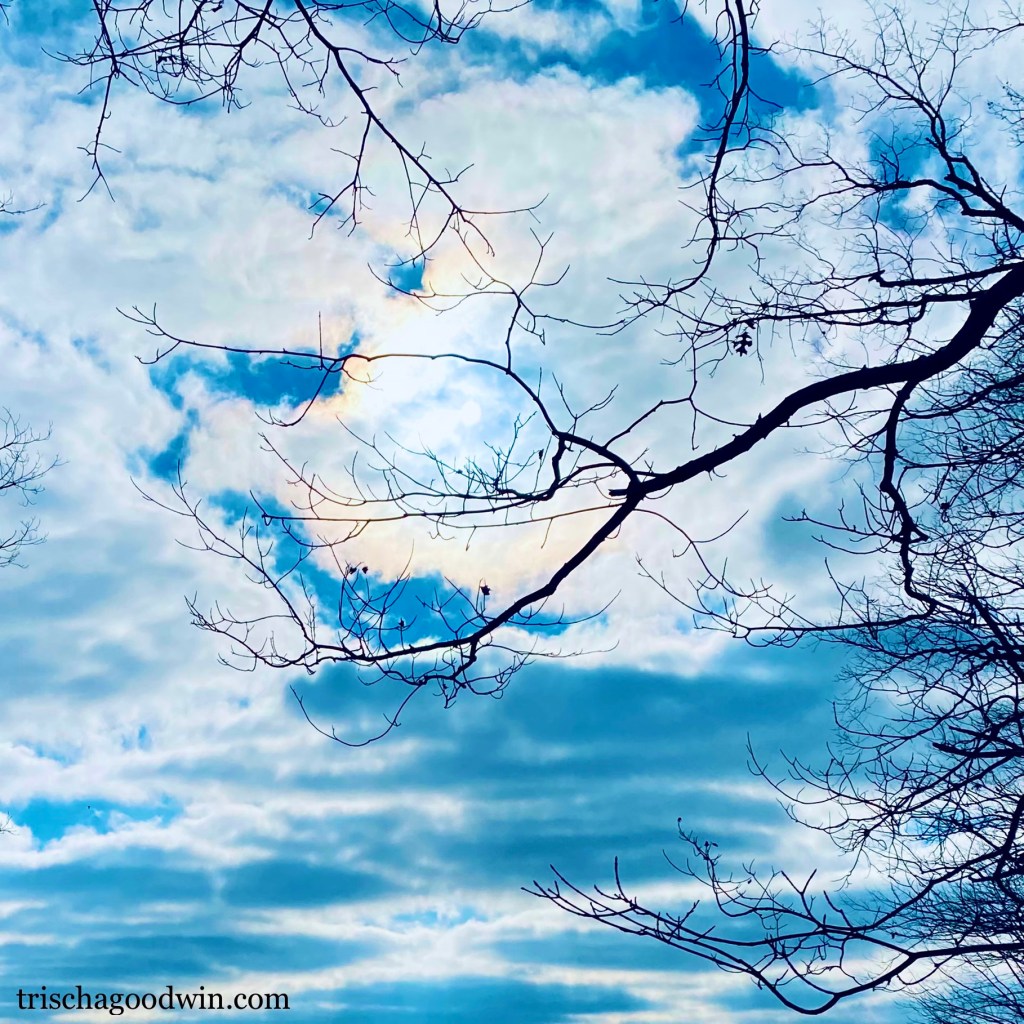
[Image description: Bare branches in front of a bright, cloudy sky]
‘In the Light: A Lament’
In the light of mourning, clarity. Sorting out which mundane things matter infinitely,
and which matters of past importance to set aside forever as time stretches out for some, past another’s time, cut short.
The unfairness pierces, piercing, pierced.
Different realities crafted to drive a wedge.
Some of us believing nurses and clinicians, experts and those bereaved, imperfectly trying to do our part. Some of us unmask our refusal to be inconvenienced for the sake of others, spreading falsehoods that kill.
Who gains when only some mourn the dead and see the weary eyes of those providing care for wave after wave after wave?
Which day do we designate for a day of mourning when thousands die every day and only some of us believe it didn’t have to be this way?
Will we ever grieve collectively the emptying seats in pews, cubicles, classrooms, break rooms, nurses stations, around dinner tables?
300,000 and counting.
When we fail to mourn together the lives lost to global tragedy because we can’t agree it is a tragedy here, the wound grows unchecked.
We need the searing light of mourning, need to allow it to shatter our hearts for the grief-stricken, the PPE-clothed witnesses, the ones no longer here.
But instead of holding vigil, we carry on like all is well or we withdraw completely or we deny or blame or fling outward an endless volley of hate.
None of which will heal or soothe or bring back a single person lost. We must find it in our hearts to grieve for the year, for our children, for ourselves, and especially for loved ones taken, and those they were taken from.
In the light of mourning, lament. As we see, bear witness, pay tribute, our hearts ache, open, and compassion can break through.
Those words hoard power to a few, leaving others in shadow, dehumanized, no questions asked.
Clinging to absolutes, to subordination, exploitation, indoctrination, will harm, destroy, and separate, but never be as powerful as all the beautiful questions.
I believe in God the Mother, Whose womb gives birth to mystery, Who nurtures all that is, Visible and invisible.
And in her strength, intuition, and softness To cradle the inner child of my heart Tenderly, soothing hurt.
I believe in the spirit of this mother To fiercely protect, Warding off attempts to wound my very nature Love from love Light from light Seeing the true essence of my being.
Through her I know my connection to all else, For me, And with me, In the feminine that is not a construct But is the abundance of mutuality, Receptivity, And fecundity.
She, who is neither opposite nor opposition, But a cosmic bringing-together Where the new unfolds. One aspect, often suppressed, Never subsumed, Always rematerializing. Moon energy, renewing after waning.
I affirm the beauty of her infinite variety Originating from the same source.
The mother presence from deep within Binding up my woundedness, Creating balance, Bringing forth wholeness as a gift to the world.
Amen
(Note: Heartfelt gratitude to Ryan Keebaugh for asking me to take on a new project that led me to these words. Looking forward to hearing how it all comes together!)
[Image description: Two bare trees in a shopping center paring lot, a single branch from each reaching out to the other, touching in the space between.]
Heart full of poetry and problems, trying to bend without breaking down completely.
Waiting without knowing what will be its worth.
Will time tell by giving birth to wholeness? Or will shame, separation, sorrow, fight it out forever?
Can poetry solve problems? Will healing ever come?
Not sure it’s possible to co-create connection, healing, hope, with nothing but this severed cord and glimmer of a different way.
Wondering if hidden in the waiting for what some of us experience as God and some as fate and some as no-god, nothing, is the mystery where that alchemy can happen.
What if the ends of healing depend entirely on the means
and those means are vulnerability, grief, seeing the other’s pain?
What if healing is an active waiting? Help and rest. Intention Care.
Perhaps what we do with waiting is the poem of the hour.
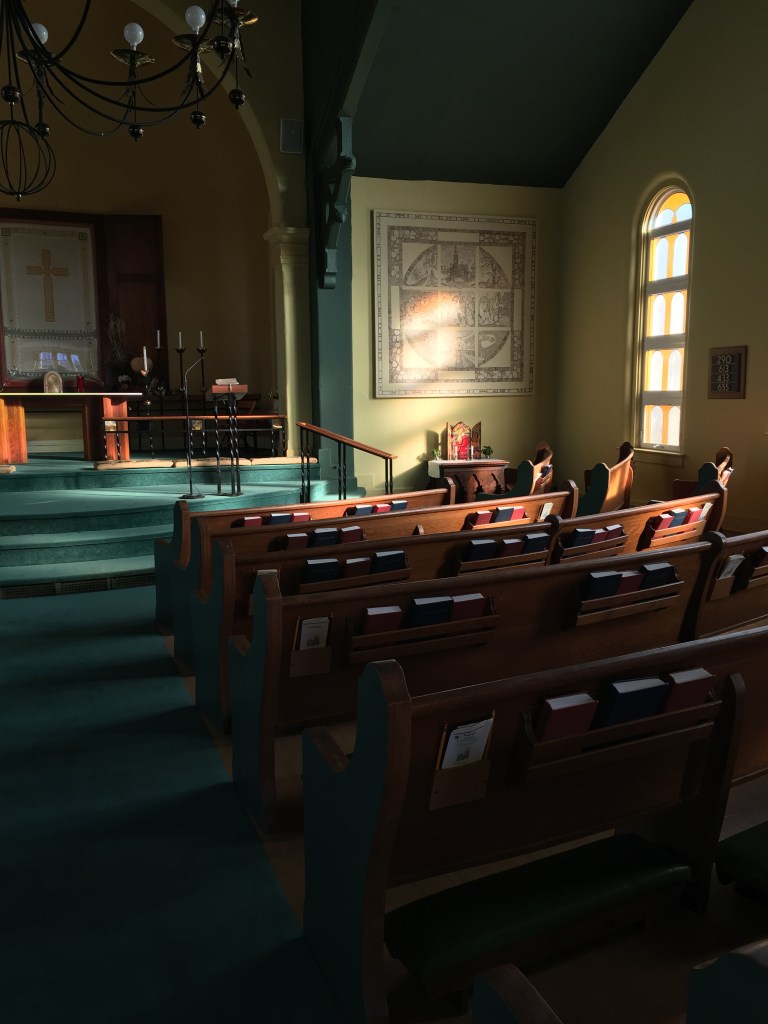
[Image description: sanctuary of St. Patrick’s Episcopal Church. Curved wooden pews, sunlight streaming through the windows, with the altar in the background.]
Note: I wrote this in 2013 after meeting with Jackie, the priest who is the rector at St. Patrick’s in Lebanon. For those who may not know this part of my story: I was raised in the evangelical church and in 2012, after a time of personal and spiritual unraveling, I stopped attending church altogether. I wasn’t sure what I believed and if I’d ever go back to church once I figured it out. In March 2013 I got up one Sunday morning, googled “Episcopal church near me,” made my way to St. Patrick’s for their late service, and have been part of that community ever since. Today is Jackie’s final Sunday before her retirement and it feels right to me to share this little glimpse into one of my first conversations with her. She has had a profound impact on my life and I’m so grateful I am able to be part of the wonderful community she has helped create over the past few decades. I wish her every blessing as she moves on to her next adventure.(Also, for several years I participated in the #OneWordChallenge and the word I chose at the beginning of 2013 was ‘weave’)
April 19, 2013
Yesterday, when I sat in the old, worn pew in the back of the sanctuary and we chatted, I have to admit I began a bit guarded. When I’d called the church office to ask about newcomer classes, she suggested that rather than waiting for them to arrange another session, I come in and meet with her, the parish priest. I know I’d readily agreed to it, but I was still a little nervous.
The rectory office was in the midst of a re-organization effort and the common area was busily being rearranged for an upcoming activity, so the sanctuary was the only free space when I arrived at our agreed time. It was mostly quiet, save for the kids from the free preschool they run listening to a lesson up on the stage. It’s not an enormous church, but the last pew is far enough back that we couldn’t hear them.
She asked about my church background and what brought me to St. Patrick’s. In a few quick minutes I explained growing up in church and then trying to find the right place after the boys were born and then becoming a church drop-out to study my faith and try to figure out where I belonged. I tried very hard not to ramble. I think I did okay.
We talked about what I’ve been reading — Richard Beck, Rachael Held Evans, Thomas Keating, Barbara Brown Taylor, Miroslav Volf. She is a good listener. Sunlight was streaming in through the windows and it felt like a holy moment, even though I’m not sure I believe there is such a thing.
Looking me in the eyes, she said, “You are so young and that is quite a journey. You are brave to keep trying. A lot of people give up.” I detected no hint of condescension or insincerity or flattery in her voice. I kept my composure and asked about her journey, but my heart was breaking open in the most excruciating and beautiful of ways.
When she considered her words and said that she knew there were some things she may be wrong about, but that she kept praying and seeking understanding and grace, I felt hopeful.
When she said that I would find people in the congregation who held opposing political and social views, she stretched her arms out wide to demonstrate the full reach of those differences. But when she assured me that the congregation strongly believes we are one in Christ and are called to share the table even with those differences, I felt like I was hearing the church I’ve been listening for.
When she said that they aren’t always perfect at it, that they are a place comprised of people which means they will never be perfect, I laughed and told her that if she’d tried to convince me her church was perfect I would have known it was not the place for me. I told her that her congregation was the most welcoming I’d ever experienced and that each Sunday at least two people I hadn’t met yet made a point of chatting with me, and she said she was very glad to hear I’d been made welcome.
She didn’t try to pressure me to continue attending or for any kind of commitment, she simply said that based on our conversation, she thinks the Episcopal church seems like a good fit for me. She encouraged me to call her if I have any questions and agreed to come up with some books for me to read to learn more about their traditions and beliefs. And then she gave me a big hug and said she enjoyed talking with me.
I waited till I got to my car to let the tears fall.
At the beginning of this year I didn’t know if I would ever feel at home in a church again. Four months later — after only six Sunday mornings there — and I can’t imagine finding anywhere else that feels more like home.
They are having a dinner/fund-raiser Saturday night to benefit the local interfaith homeless ministry. She’d seen that I signed up to attend and as we discussed it, she mentioned that she is going to speak for a few minutes beforehand. The topic? Weaving the Fabric of Life.
Maybe there is the slightest possibility I do believe in holy moments after all.
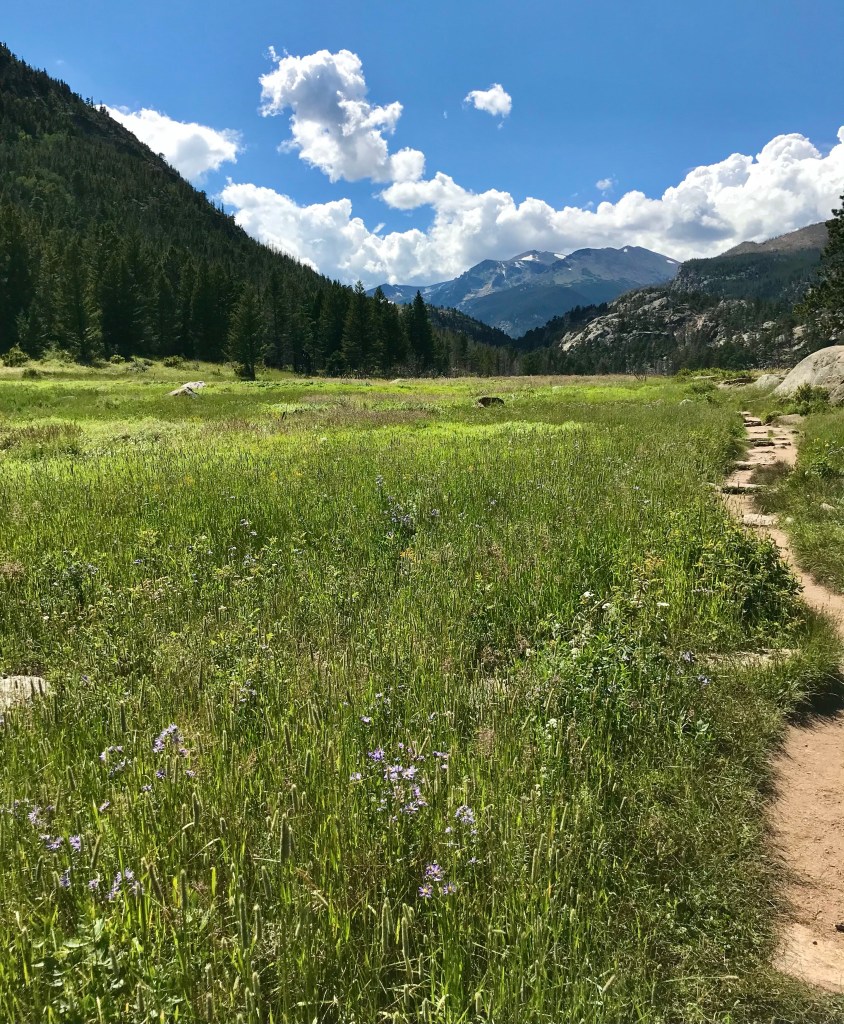
[Image Description: Dirt path along the side of a meadow in Rocky Mountain National Park, mountains in the distance.}
What will people think? Always bear that question.
They will know we are Christian by our christian values, christian t-shirts, and prayers around flagpoles at public schools we don’t even attend because we are separate, not of them.
Listen to us, your elders, we will show you the way you should go, to mold you into the perfect christian image.
You will not lie. You will not mock. You will not disrespect. You will not forget your manners. You will not lust. You will not cheat, or you deserve just what you get.
If you disobey you deserve the blistered bottom, the lost meals, the harsh words, the shaming, the threat of being shunned. And you will call your friend and tell her you can’t attend her birthday because you broke the rules.
These are the consequences I learned.
You taught them from your sanctuaries, your kitchen islands, your youth group bible studies, your conferences, your words, and I believed you
until I didn’t.
Until I saw the fear I was painting on my own children’s faces, the pain I caused, the shame I inflicted, when I doled out the same manufactured consequences.
Love had to be another way.
Love is kind, patient, protects, does not grow calloused to another’s pain.
But you said I was going astray, ruining them. They would never know right from wrong.
Now I see that was the ruse all along.
To excuse lying if it gets you the court seat To excuse mocking if it only targets “them.” To excuse disrespect if you think it’s deserved To excuse lust if it might have been a joke To excuse gaming the system if it gets you what you want.
To think the end justifies the means, while keeping us all from seeing the means are often everything you told me was wrong.
You would have been my elders but now we’re just adults on different paths with different understandings of God.
I know this sounds like anger. I have been angry. I have argued and tried to convince. I tried to go and never look back.
But I now I see another truth: We’re still part of each other. We were all caught up in the same misguided tide. And my rage, my desperate attempts to convince you, my wanting you to be ashamed for your complicity, have roots in the same poisoned well.
More shame or pain or hurt will never turn the tide. Even if the ruse tells us it’s deserved.
This is the hard part, it calls for courage, for unguardedness I’m not sure that I possess.
I still have far to grow.
I know I can’t come back, But I can be here, arms unclenched, in this loving, spacious wilderness, holding this painful tension, trying, while love beckons you with kindness, with patience, with your own new path.
Because the good news isn’t politics and anger, punishment and fear.
It’s letting go. Breaking free. And finding life anew.
It’s not natural to us, not our nature, to embrace duality, not each other. It’s manufactured for their profit, like their power, like the system, inflating as we buy in.
When we sanction this detachment, choosing Ideology, Rhetoric, Catastrophizing, Shame, the machinations infiltrate, trojan horse, wreaking havoc from within.
The chasm between our hearts expands unconstrained. While we suffer broken lives and broken bonds, the officialdom’s interests served by our misplaced discontent.
This division, lined with border walls and severed ties, mirrors back our worst projections. We get caught up, lose ourselves, lose each other to the machinery for whose gain?
We aren’t meant to cling to separations, grasping empty metallic promises churned out from the engine of the status quo.
We’re meant to live in seasons— Sowing and growing Renewing and letting go— the living things we are.
Neither manufactured division nor false unity will save us. Only clear seeing of complexity, of the need to repair harm, of the unsustainability of this us vs. them, all or nothing, dichotomy.
We are too much, too many to be flattened into two.




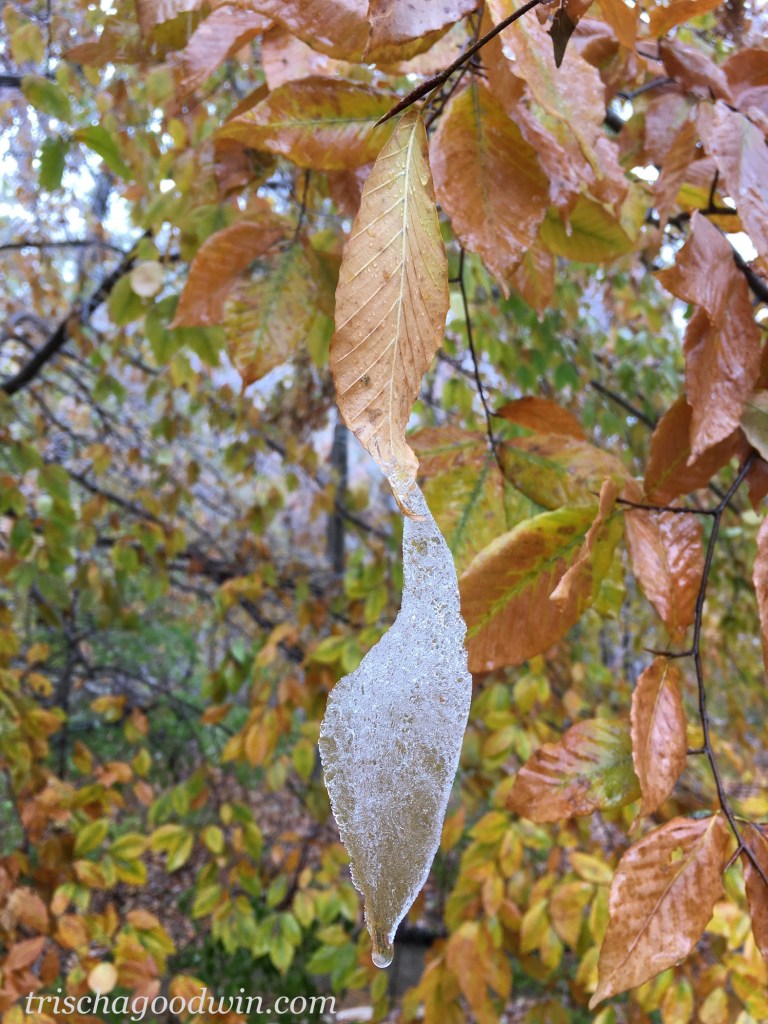
 The Forest and the Trees